The Unity–Polarity Axioms (UPA) were first developed as an abstract framework: a way of describing, in clean structural terms, how unity, opposites, context, integration, and agency hang together.
That’s already powerful.
But if UPA is to ground Open SGI, psychology, neuroscience, and multi-agent systems in a rigorous way, we need more than conceptual clarity. We need a mathematical space where:
- Opposites can be placed.
- Contexts can bend behavior.
- Integration can be represented as movement.
- Harmony can be measured.
- Safety can be certified.
This is where geometric realization enters—specifically, spheres and hyperspheres (S², Sⁿ).
This post introduces the idea and explains why spheres are the natural geometric home for UPA. Later posts in this series will progressively unpack the formal structures.
1. From Abstract Axioms to Concrete Shapes
UPA asserts that:
- There is one coherent field (A1 Unity).
- Within it, opposites (A2 Polarity) arise and co‑define each other.
- Their expression depends on context (A7).
- They may be integrated (A14–A16).
- Systems can generate new layers, worlds, and distinctions via agency (A17–A18).
These are conceptual truths.
Geometric realization asks a new question:
Can we construct a mathematical space where these ideas become explicit, manipulable, measurable structures?
The answer developed in Appendix C is yes, by using:
- S² for single polarity axes.
- Sⁿ for multi-axis polarity.
On these manifolds:
- Each pole becomes a point.
- Opposites become antipodes.
- Integration becomes movement along geodesics.
- Harmony becomes angular balance.
- Novelty becomes adding dimensions.
- Hierarchy becomes nested spheres.
UPA gives us the structural principles.
Geometry provides the stage and mechanics.
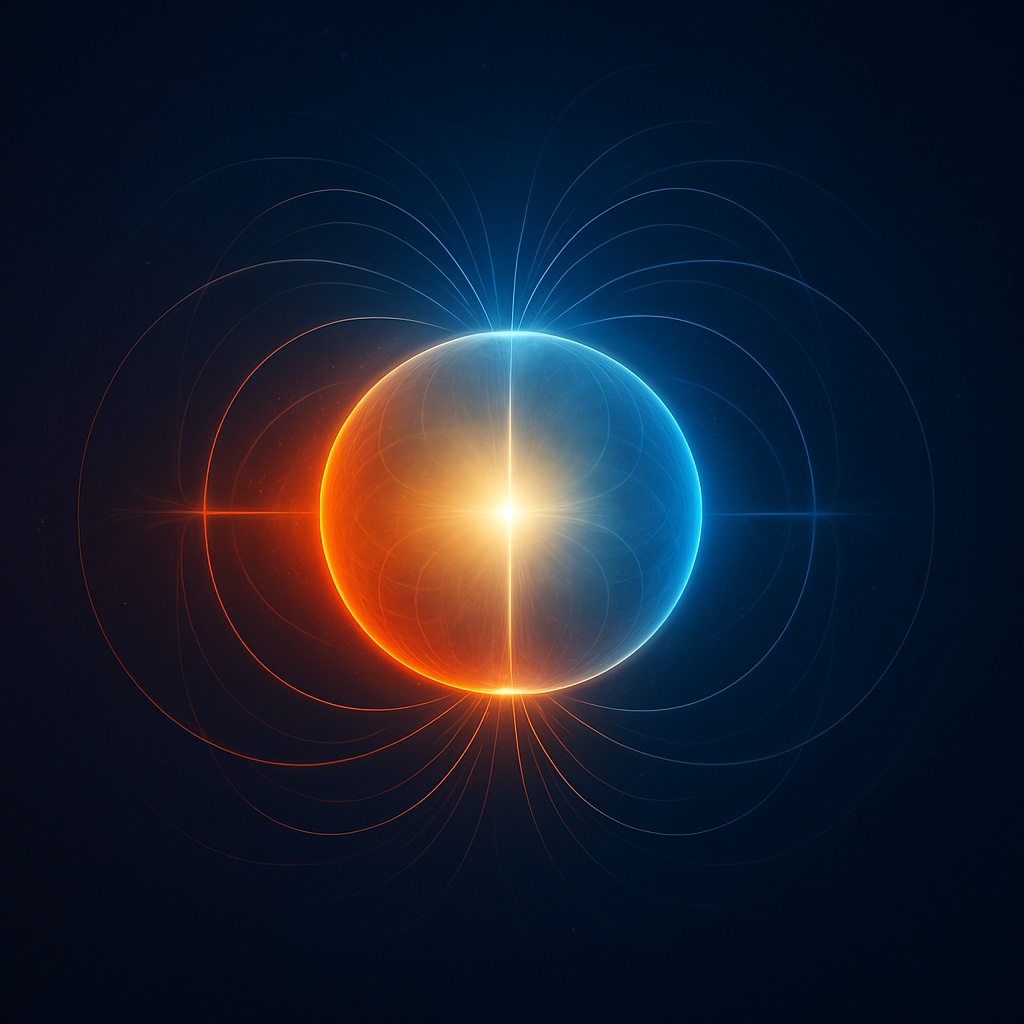
2. Why Spheres (S²) Naturally Encode Polarity
The simplest nontrivial geometric space that intrinsically encodes opposites is a sphere.
Imagine a globe:
- Pick one point and call it a pole—e.g., autonomy.
- The exact opposite point (180° away) becomes belonging.
These two points are antipodal.
This neatly models several UPA principles:
- A2 — Polarity: the poles co‑define each other.
- A6 — Involution: the σ-operation is just an antipodal reflection.
- A15 — Harmony: the arc between poles represents integrative states; midpoints correspond to balanced configurations.
Later posts will develop the mathematics, but the intuition is straightforward:
Spheres give us the cleanest possible representation of “this vs. that.”
Already this lets us map:
- Psychological tensions (e.g., autonomy ↔ belonging)
- Neural functional pairs (e.g., excitation ↔ inhibition)
- SGI tradeoffs (e.g., safety ↔ performance)
- Ethical tensions (e.g., liberty ↔ order)
A single sphere captures the geometry of one polarity.
3. From S² to Sⁿ: Modeling Many Polarities at Once
Real systems rarely operate along one axis.
Humans, societies, and SGI models juggle many:
- autonomy ↔ belonging
- stability ↔ change
- analysis ↔ synthesis
- local ↔ global
- safety ↔ performance
- transparency ↔ complexity
To represent multiple polarity axes simultaneously, we use higher-dimensional spheres (Sⁿ):
- Each polarity axis becomes a dimension.
- Each pair of poles becomes antipodal points in that dimension.
- A complete state of the system becomes one point on Sⁿ.
This allows us to:
- Model multi-axis tradeoffs (T4).
- Represent multi-dimensional harmony (A15).
- Visualize identity, personality, values, and context.
- Model SGI internal semantic state rigorously.
UPA says complex systems express many axes at once.
Sⁿ gives us a single coherent space to represent them.
4. What Geometry Gives Us
By committing to geometric realization, UPA gains:
4.1 Visualization
- Poles, paths, basins, and trajectories become visible.
- We can see where a configuration lies along one or many axes.
- We can animate how change unfolds.
4.2 Formalization
- Axes = dimensions.
- Polarity = antipodal symmetry.
- Integration = geodesic motion.
- Harmony = angular metrics, viability regions, basins.
UPA moves from conceptual clarity to mathematical precision.
4.3 Simulation
- Learning becomes movement on Sⁿ.
- Novelty becomes temporary expansion into higher dimensions.
- Recursive identity becomes hierarchy via nested spheres.
This opens the door to testable, reproducible SGI behavior.
4.4 Integration Across Domains
Psychology, neuroscience, social theory, and SGI no longer need separate formalisms. All can be represented in:
- A common hyperspherical coordinate system.
- With shared axes.
- Governed by the same invariants.
4.5 Harmony & Certification
Geometric metrics allow:
- Viability checks (A15).
- Safety certification.
- Detection of imbalances and distortion.
- Transparent reasoning about SGI behavior.
Geometry makes alignment auditable.
5. How This Supports Siggy and Open SGI
For Open SGI and PER/Siggy:
- Internal semantic state becomes a point in Sⁿ.
- Personality/values/preferences live in named regions.
- Learning uses tangent-space gradients and exponential maps.
- Safety uses geometric invariants and harmony thresholds.
- Human–SGI interaction uses shared or bridged subspaces.
This geometric foundation enables Siggy to be:
- transparent,
- predictable,
- testable,
- certifiable,
- and free of “evolutionary flaws” such as hidden heuristics or maladaptive habits.
UPA + geometry = powerful, accountable SGI.
6. What Comes Next in the Geometric Series
This first post provides motivation and orientation. Upcoming posts will develop the details:
- Polarity on the Sphere (S²) — antipodes, great circles, harmony.
- From S² to Sⁿ — multi-axis polarity and dimensional semantics.
- Learning on Curved Spaces — arithmetic and calculus on Sⁿ.
- Coordinates, Levels, Initialization — how an SGI enters semantic geometry.
- Harmony & Path Dynamics — geodesics as minimal-change transformations.
- Novelty & Hierarchy — dimensional growth and nested identity.
- Context Fields & Local Harmony Laws — environments shaping trajectories.
- Certification Invariants — geometric safety criteria.
- Multi-Agent Geometries — shared spaces for humans & SGI.
All posts will link theory to real examples from psychology, neuroscience, and SGI.
 Open Autonomous Intelligence Initiative
Leave a comment