
Open Autonomous intelligence initiative
Download the Axiomatic Ontology (AO) Foundation paperDownload the AO Research Program paper
Download the AO Matter Reconstruction Pass 1 Analysis paper
Open Autonomous Intelligence Initiative
Open object-oriented models for accountable AuI
-

-

σ‑Pair Intelligence in Siggy: How Open SGI Learns Ethical Balance on the Edge
This post explains how σ-pair evaluation gives Siggy the ability to balance autonomy, safety, privacy, and routine as a personalized edge-first SGI. Through Harmony Rules, user-specific learning, and world-indexed context, Siggy becomes a safe and adaptive companion for aging in place. Open SGI defines the framework—life fills in the values.
-
Siggy Edge-First Learning Architecture
Siggy is a personalized, edge-first SGI that learns a user’s routines, mobility, and wellbeing patterns over time—privately and safely. This post explains how Siggy uses Harmony Rules, σ-pair evaluation, and world-indexed learning to support aging-in-place with dignity. Open SGI provides the structure; the user provides the lived experience.
-
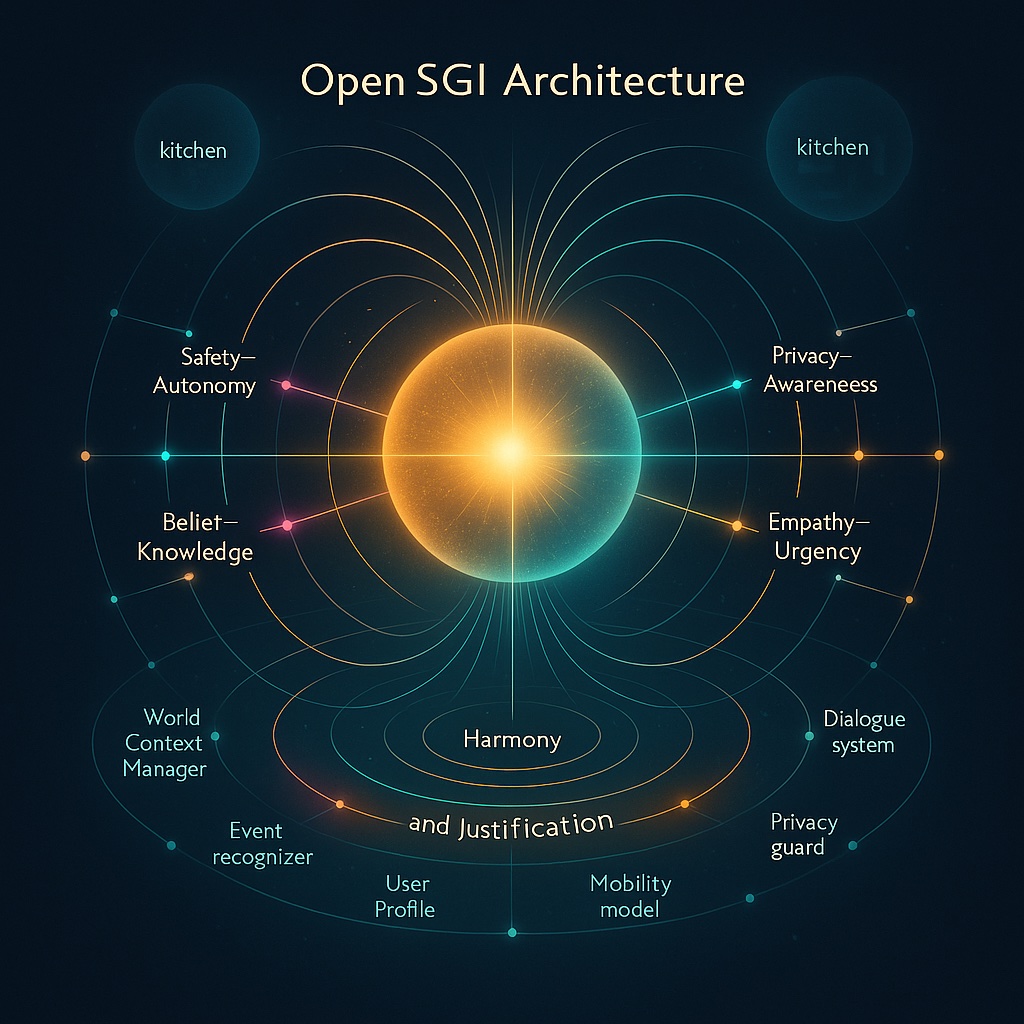
Open SGI Architecture for Personal Event Recognition Systems
Open SGI defines the OAI² reference architecture for ethical, intelligent aging‑in‑place systems. This post outlines a UPA‑aligned framework where IoT sensors, wearables, and robotics interact through world‑anchored reasoning—transforming data to knowledge with traceable justification and continuous harmony. It serves as the foundation for OAII certification and the Open SGI standard.
-
Open SGI v2: Inheritance & Containment Model for Trusted Intelligence
Open SGI v2 defines a world-anchored inheritance and containment structure for data, information, belief, and knowledge. Built on Unity–Polarity Axioms, this model supports cross-world mappings, rule-based evaluation, and service-layer integration—advancing explainability, safety, and certification paths in SGI.
-
SGI Epistemic Representation Across Worlds & Time
In SGI, knowledge isn’t universal—it’s world-bound. Every signal, interpretation, belief, or conclusion is indexed to a specific world and time. The same flash might mean lightning in one world and solar reflection in another. SGI tracks how meaning evolves through a simple chain: Data → Information → Belief → Knowledge This framework lets SGI remember,…
 Open Autonomous Intelligence Initiative