Introduction
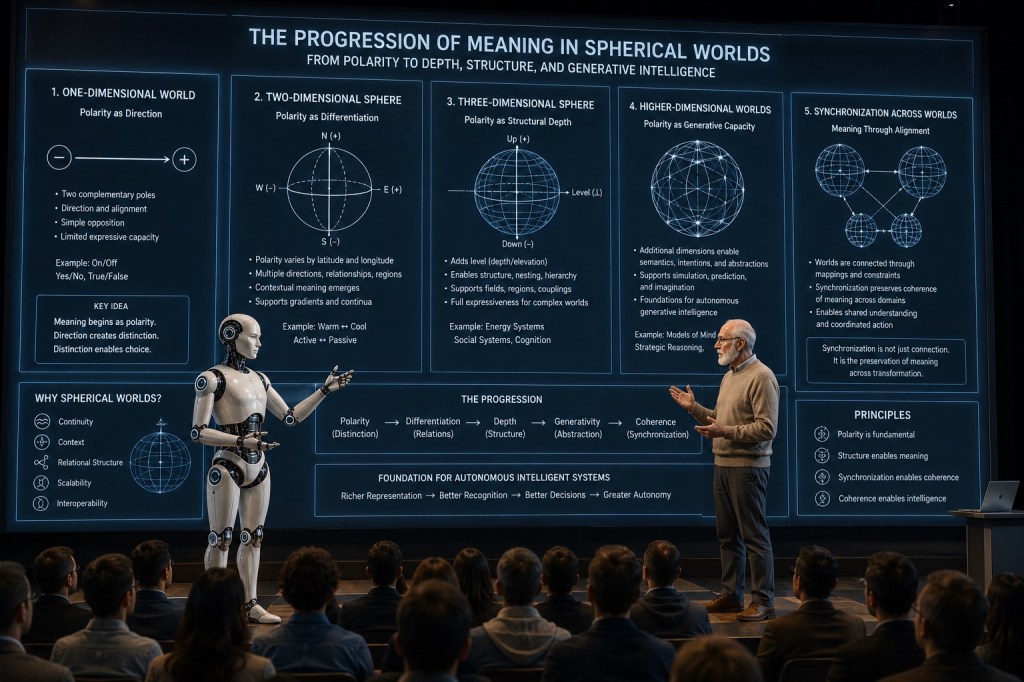
One of the central ideas in the Polarity Modeling Framework (PMF) is that polarity defines the organizing structure of a world. As additional dimensions are introduced, the meaning of polarity changes because the resulting structure is no longer adequately represented by a line or a simple opposition, but instead develops into a sphere capable of representing differentiation, coexistence, context, and transformation.
This progression is important because many existing approaches to modeling intelligent systems treat meaning as either categorical or vector-based without clearly explaining how complex structure emerges from primitive distinctions. PMF approaches the problem differently. It begins with polarity as the most primitive organizing relation and then examines how richer forms of structure emerge as dimensions are added.
The progression from one-dimensional polarity to multi-dimensional spherical worlds is therefore not only geometric. It is semantic and structural. Each additional dimension changes what the world is capable of representing.
One-Dimensional Polarity
The simplest polarity structure is one-dimensional. At this level, a world is organized around a single polarity axis:
P ↔ not-P
This defines two poles representing complementary aspects of a distinction. Examples might include:
- active ↔ inactive
- stable ↔ unstable
- occupied ↔ unoccupied
- safe ↔ unsafe
- engaged ↔ disengaged
In a one-dimensional world, meaning is fundamentally directional. A configuration can only vary along the polarity axis itself. The primary semantic structure is progression toward one pole or the other.
At this stage, polarity represents:
- opposition
- complementarity
- alignment
- degree of orientation toward a pole
A one-dimensional world supports comparison and ordering, but very little differentiation. Two configurations may differ in degree, but not in type. There is no room for multiple independent variations because every change is projected onto the same axis.
This structure resembles a line segment more than a sphere. It is useful for expressing simple gradients, thresholds, or binary distinctions, but it cannot adequately model the richness of real autonomous intelligent systems.
For example, a personal event recognition system that only models occupied ↔ unoccupied may determine whether a room contains a person, but cannot distinguish among sleeping, reading, eating, pacing, or exercising. All activity collapses into a single dimension.
One-dimensional polarity therefore establishes the primitive concept of organized distinction, but it does not yet provide sufficient structure for representing complex configurations.
The Emergence of Two-Dimensional Structure
When a second independent dimension is introduced, the meaning of polarity changes fundamentally.
The system no longer represents only movement toward one pole or the other. It can now represent differentiation across an additional dimension while preserving the original polarity structure.
This produces a spherical interpretation because configurations are no longer constrained to a single line of progression. They can vary around the world while still maintaining orientation relative to the primary polarity.
In PMF terms, this introduces the distinction between:
- progression
- differentiation
The first dimension still represents movement toward or away from the poles. The second dimension allows configurations to differ without necessarily becoming more aligned with either pole.
This is the conceptual basis for latitude and longitude in PMF worlds.
Latitude represents relative orientation toward the poles. Longitude represents differentiation around the world.
This changes the meaning of polarity significantly.
In a one-dimensional system, difference implies greater or lesser alignment with a pole. In a two-dimensional world, two configurations may be equally aligned with a pole while differing substantially from one another.
For example, two individuals may both be highly engaged within a learning environment while exhibiting very different styles of behavior, interests, emotional states, or interaction patterns. One-dimensional polarity cannot represent this distinction. Two-dimensional spherical structure can.
This is the point at which polarity stops functioning merely as opposition and begins functioning as a field of organized variation.
The world now supports:
- variation without contradiction
- coexistence of differentiated structures
- regions of similar configurations
- multiple paths of transformation
- partial similarity rather than simple binary distinction
Meaning becomes contextual rather than purely directional.
Spherical Interpretation in Two Dimensions
The spherical interpretation is not merely metaphorical. Once multiple dimensions of variation exist around a polarity axis, the natural structure becomes spherical because all configurations remain organized relative to the poles while simultaneously supporting differentiation around the world.
This allows the world to represent:
- proximity
- distance
- clustering
- continuity
- boundaries
- trajectories
- regions
The resulting structure supports concepts that are difficult to express in purely symbolic or relational systems.
For example:
- two configurations may be near each other without being identical
- transformations may preserve some dimensions while altering others
- regions may emerge from recurring configurations
- boundaries may form gradually rather than absolutely
This provides a much richer basis for modeling AuI systems.
In edge-primary personal event recognition, this distinction becomes critical. A system may recognize multiple forms of “active occupancy” that differ structurally while still belonging to the same broader region. Cooking, cleaning, exercising, and pacing may all occupy nearby but distinct regions of a shared world.
The spherical structure allows similarity and differentiation to coexist.
Three-Dimensional Worlds and Structural Depth
The addition of a third dimension changes the meaning of polarity again.
At this stage, the world can no longer be understood only in terms of orientation and differentiation. It now supports structural depth.
This additional dimension allows the system to distinguish between:
- superficial variation
- persistent organization
- hierarchical structure
- compositional complexity
- stability across transformation
In PMF, this dimension is associated with level.
Level introduces the ability to represent not merely where a configuration exists relative to a polarity axis, but how structurally developed, persistent, or compositionally organized that configuration is.
This is important because many intelligent systems require distinctions that cannot be expressed solely through alignment and differentiation.
For example:
- two behaviors may appear similar externally while differing greatly in structural complexity
- two regions may exhibit similar configurations while differing in persistence or stability
- a temporary pattern and a stabilized knowledge structure may occupy similar locations while differing in level
Three-dimensional spherical worlds therefore support:
- nested structure
- compositional organization
- persistence across transformations
- hierarchy without abandoning continuity
- richer forms of contextual interpretation
At this stage, polarity becomes the organizing basis of a structured world rather than a simple binary distinction.
Why Spherical Worlds Matter
The progression from one-dimensional polarity to spherical worlds matters because it changes what the framework can represent.
One-dimensional systems can represent direction and degree.
Two-dimensional systems can additionally represent differentiation and coexistence.
Three-dimensional systems can additionally represent structural depth, persistence, and compositional organization.
This progression mirrors the increasing complexity required for modeling autonomous intelligent systems.
Simple systems may only require binary distinctions.
More advanced systems require:
- context
- similarity
- differentiation
- region formation
- multiple transformation paths
- knowledge stabilization
- cross-domain mappings
- regulatory coherence
These capabilities require worlds that are richer than lines or flat categorical structures.
Spherical worlds provide that richer structure while preserving polarity as the organizing principle.
Relationship to Fields, Regions, and Transformations
The progression of dimensionality also changes the meaning of fields, regions, and transformations.
In a one-dimensional system:
- fields are minimal
- regions are limited
- transformations are primarily directional
In a two-dimensional world:
- fields support continuity across differentiated configurations
- regions emerge naturally from clustering
- transformations may preserve orientation while altering differentiation
In a three-dimensional world:
- fields support layered and persistent organization
- regions may contain subregions and nested structure
- transformations may alter structural depth as well as orientation and differentiation
This progression allows PMF to support increasingly sophisticated forms of system behavior.
Implications for AuI
AuI systems must continuously interpret, transform, and regulate complex configurations.
A purely binary or flat representational structure is insufficient for:
- contextual reasoning
- adaptive behavior
- event recognition
- policy evaluation
- knowledge stabilization
- multi-domain integration
- cross-world coordination
Spherical worlds provide a structural basis for representing these capabilities.
They allow systems to:
- distinguish between progression and differentiation
- maintain continuity across variation
- organize regions of similar meaning
- represent structural persistence
- support multiple transformation trajectories
- integrate heterogeneous domains through mappings
This makes spherical worlds particularly relevant for OAII and edge-primary autonomous intelligence systems.
Edge-Primary Personal Event Recognition Example
Consider a home-based personal event recognition system.
In a one-dimensional model, the system may only represent:
- occupied ↔ unoccupied
This supports basic presence detection but little else.
In a two-dimensional spherical world, the system may additionally distinguish among:
- cooking
- exercising
- pacing
- resting
- cleaning
while still recognizing all of these as forms of occupancy.
The second dimension allows differentiated activity patterns to coexist within the same broader world.
In a three-dimensional world, the system may additionally distinguish:
- temporary activity
- stabilized routine
- anomalous behavior
- learned preference
- persistent habit
The system can now represent not only what activity is occurring, but how structurally stable, recurrent, or significant that activity is.
This progression demonstrates why additional dimensions matter. Each dimension increases the expressive capacity of the world and changes the meaning of polarity itself.
Beyond Binary Thinking
One of the most important consequences of spherical worlds is that polarity ceases to imply simplistic binary opposition.
In PMF, polarity is not intended to reduce reality to two categories. Instead, polarity provides the organizing tension around which rich worlds of variation, differentiation, and structure emerge.
The poles remain essential because they define orientation and coherence. However, most meaningful configurations do not exist only at the poles. They exist throughout the world, within regions shaped by coupling, transformation, context, and regulation.
This allows PMF to preserve the organizing power of polarity while avoiding the limitations of rigid binary systems.
Relationship to Existing Approaches
Many existing systems represent meaning using:
- symbolic categories
- relational databases
- vector embeddings
- probabilistic state spaces
- graph structures
Each of these approaches captures some aspects of organization, but they often lack a unified structural account of:
- polarity
- differentiation
- continuity
- transformation
- contextual organization
- structural depth
Spherical worlds attempt to provide such a framework.
The goal is not to replace all existing representations, but to provide a structural foundation capable of integrating them within a coherent model of autonomous intelligence.
Next Steps
The progression from one-dimensional polarity to spherical worlds establishes the structural basis for richer PMF constructs.
Future work must further formalize:
- latitude as progression and orientation
- longitude as differentiation without ordering
- level as structural depth and persistence
- coupling across dimensions
- transformations within and across regions
- mappings among worlds
- temporal projection over transformation systems
- regulation of admissible configurations and transformations
Additional work is also needed to formalize:
- region formation
- field continuity
- cross-world synchronization
- structural coherence conditions
- implementation projections for computational systems
The broader goal is to establish PMF not merely as a conceptual vocabulary, but as a disciplined structural framework for modeling autonomous intelligent systems.
The progression of meaning across spherical worlds is one step in that direction. It shows that polarity is not merely a binary distinction, but the organizing principle from which increasingly rich forms of structure, interpretation, and autonomous behavior can emerge.


Leave a Reply