Toward an Open Structural AuI Model and an Edge-primary example
The Open Autonomous Intelligence Initiative has reached an important transition point. The prior work on polarity, structural modeling, spherical worlds, temporal projection, regulation, and constraint boundaries has produced a sufficiently developed conceptual foundation to support a new phase of work. The immediate task is no longer to continue expanding the framework in the abstract. The immediate task is to use the framework to define implementable specifications for open, transparent, edge-primary AuI.
This post records the conceptual and naming changes that will guide that transition. It does not revise or replace the earlier work. The earlier work remains part of the intellectual history and technical background of OAII. The current move is a narrowing and operationalization of focus: from broad framework development toward core OAII AuI specifications and an example model for Edge-primary Personal Event Recognition (PER).
1. The Prior Development Path
The work that led to the current OAII direction began with broad structural questions. Could a coherent model be developed that integrated many different kinds of domains, levels, boundaries, regions, forces, and transformations? Could such a model be expressed in a way that was internally consistent, geometrically meaningful, and capable of supporting later formalization?
Early work explored ideas related to holistic unity, including the question of how wholes, parts, relations, and boundaries could be represented without reducing one to the other. This led into the Unity Polarity Axioms (UPA), where polarity was investigated as a structural relation capable of organizing complementary aspects within a unified system. That work produced axioms, theorem-like claims, applications, and geometric interpretations.
The UPA work was then reinterpreted through AIM, the Axioms of Intelligibility and Mind. AIM explored whether polarity-based structures could support a broader account of intelligibility, experience, interpretation, and mind. This phase was valuable because it refined many of the structural insights used by OAII, including polarity, regions, transformations, and multi-level coherence within spherical worlds.
Most recently, the work was in the process of being revised and redirected through the Polarity Modeling Framework. PMF shifted the emphasis from broad metaphysical or philosophical modeling toward structural modeling for autonomous intelligence (AuI). That shift has now advanced far enough to support a further narrowing: PMF will serve as the structural foundation for OAII specifications for Simulated General Intelligence.
2. The New Primary Focus: Autonomous Intelligence (AUI)
The central focus of the current OAII effort is now AuI.
AuI does not mean artificial consciousness, human-equivalent mind, or biological intelligence reproduced in machines. It means general autonomous and intelligent behavior modeled and implemented through explicit, inspectable, artificial structures. In OAII usage, AuI means structurally represented, operationally implemented, and computationally testable.
A working definition is:
AuI is the modeled capacity of an artificial system to represent context, recognize meaningful transformations, transform internal configurations, regulate action, learn stabilized structures, and adapt across domains without claiming biological consciousness or human-equivalent mind.
This definition clarifies the scope of OAII. The goal is not to explain all human intelligence, animal intelligence, consciousness, or mind. Human and non-human intelligence may still serve as reference domains. They provide examples of perception, routine, attention, interruption, adaptation, memory, regulation, and context-sensitive behavior. But they are not the formal target of the present OAII specifications.
The formal target is AuI as an implementable class of artificial systems.
3. The OAII Structural Intelligence Model
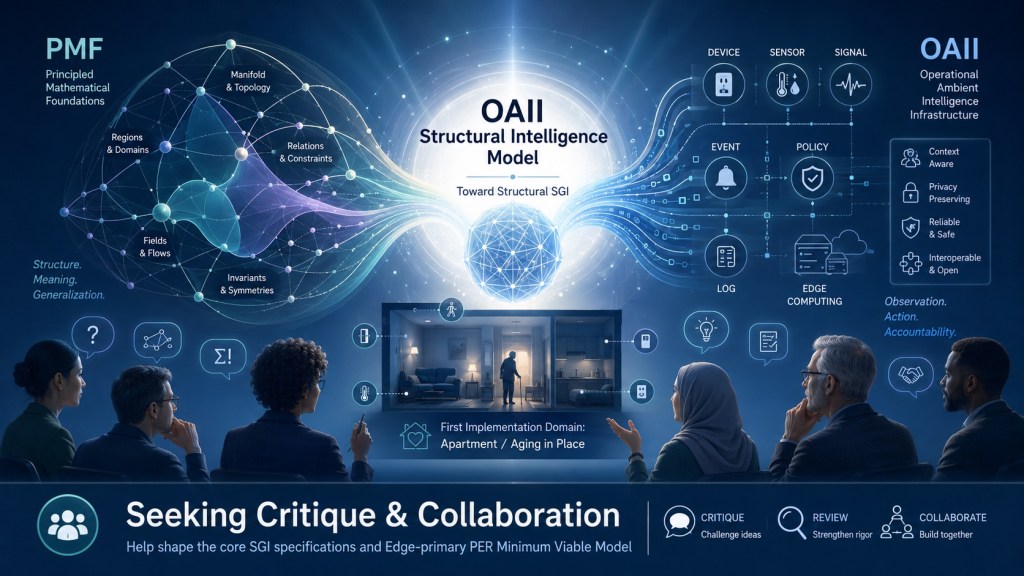
The integrated model that brings OAII and PMF together is the OAII Structural Intelligence Model, described as follows:
The OAII Structural Intelligence Model is an open operational model for transparent, edge-primary autonomous intelligence.
A more technical description is:
The OAII Structural Intelligence Model is a polarity modeling framework (PMF) grounded operational model that represents autonomous intelligent behavior through structured context, transformation, regulation, temporal projection, knowledge, events, policy, and logs.
This name is intentionally more accessible than PMF-specific terminology. It describes the purpose of the work without requiring a new reader to first understand polarity, spherical worlds, or formal structural modeling. Those concepts remain important, but they belong primarily in technical specifications, reviewer notes, implementation documents, and formal appendices.
The name also avoids presenting OAII and PMF as two separate frameworks that must be stitched together. PMF provides the structural foundation. OAII provides the operational object model, interfaces, logging, policy structure, implementation profiles, and certification path. The OAII Structural Intelligence Model is the integrated result.
4. PMF as the Structural Foundation
PMF is and will be used as the structural foundation for SGI. It defines the constructs required to represent meaningful differences, context, regions, transformations, temporal projection, regulation, constraint boundaries, stabilized knowledge, and auditable system behavior.
In technical terms, PMF provides the structural logic of the OAII model. OAII then expresses that structure as operational classes and implementation specifications.
This distinction is important. PMF gives OAII more than a collection of object types. It gives OAII a way to say why those objects belong together and how they support intelligent behavior. Signals are not isolated inputs. Events are not isolated occurrences. Policies are not external rules added after the fact. Logs are not merely records. Each can be interpreted as part of a structured system of configurations, transformations, regulation, and traceability.
5. De-emphasizing Polarity in Public-facing Material
Polarity remains a foundational technical concept, but it will be de-emphasized in public-facing material.
This is a communication decision, not a theoretical retreat. The word polarity can sound abstract, philosophical, or metaphysical before a reader understands the practical problem OAII is trying to solve. Most public audiences do not need to hear the word polarity first. They need to understand that OAII is developing open, transparent, edge-primary models for systems that can recognize meaningful events, apply explicit policies, preserve privacy, and maintain auditable accountability.
Public-facing material will lead with terms such as:
- structural intelligence
- context
- event recognition
- transformation
- regulation
- temporal projection
- privacy-preserving edge intelligence
- open autonomous intelligence (AuI) systems
- auditability and certification
Polarity, level, and world remain foundational and appear in the more technical material for the Data Scientists, who will understand them and know where and why they are needed.
A simplified and useful explanation that captures all of this is:
OAII models AuI behavior in terms of structured relationships: signals in context, events as transformations, policies as constraints, and logs as auditable records. These structured relationships are formalized as polarity-based world configurations.
6. From OAII Base Model to Integrated Structural Model
The OAII Base Model should now be redeveloped in PMF terms. The goal is a single integrated model rather than two parallel frameworks.
The core integration principle is:
PMF defines the structural logic of simulated intelligence. OAII defines the implementable object model structure.
This means existing OAII operational classes can be reinterpreted through PMF rather than discarded.
A preliminary mapping is:
| OAII operational class | PMF-grounded interpretation |
|---|---|
| Device | Physical or virtual host participating in a field, world, or implementation context |
| Sensor | Source of signals that update system configuration |
| Signal | Observable input contributing to a position, configuration, or event candidate |
| Event | Operational representation of a recognized transformation |
| Knowledge | Stabilized learned transformation data organized by world, region, field, and routine. |
| Agent | Actor or process that selects, evaluates, or performs admissible transformations |
| Log | Persistent record of signals, configurations, transformations, events, policies, temporal projections, and actions |
This mapping creates a unified conceptual and operational model. The OAII classes remain practical and implementable, while PMF gives them structural meaning.
7. The First Implementation Profile: Edge-primary PER
The first implementation profile for the OAII Structural Intelligence Model will be Edge-primary Personal Event Recognition, focused initially on aging-in-place.
Personal Event Recognition, or PER, means recognizing meaningful events in a person’s daily life from local sensor evidence, learned routines, explicit policies, and contextual interpretation. Edge-primary means that sensing, interpretation, event recognition, policy evaluation, and logging should occur locally wherever practical, with cloud dependence minimized or avoided.
The initial PER domain is aging-in-place because it requires exactly the capabilities the OAII model is intended to support. A useful system must recognize events without becoming intrusive. It must distinguish routine from anomaly, interruption from emergency, resident activity from visitor activity, sensor uncertainty from meaningful change, and privacy-preserving monitoring from invasive surveillance.
This makes aging-in-place PER an ideal first SGI testbed. It is constrained enough to implement, but rich enough to require context, transformation, regulation, temporal projection, knowledge, policy, logs, and accountability.
8. The example Model
The immediate goal is an OAII model example of an edge-primary system that can:
- collect local signals from simple sensors
- convert signals into structured configurations
- recognize event candidates
- interpret event candidates within context
- distinguish routine, interruption, ambiguity, anomaly, and possible distress
- apply explicit policy and regulation before acting
- project transformations into temporal order and duration
- maintain privacy-preserving logs
- provide a traceable explanation of any alert or non-alert
- update stabilized knowledge only when admissible evidence supports doing so
This MVM is more important than an early polished product. It will show whether the OAII Structural Intelligence Model can be made operational.
9. The Example: Interrupted Morning Routine
The proposed use case is an interrupted morning routine in a small residence.
An older adult lives in an efficiency or small one-bedroom apartment. A normal morning routine may include waking, bathroom use, kitchen activity, medication, coffee or breakfast, and transition into an active morning state. One morning, the resident begins the bathroom portion of the routine. During or shortly after that interval, a phone rings or a doorbell sounds. The routine may be resumed, delayed, aborted, or replaced by a different activity. Additional ambiguity may arise if another person is present and uses the kitchen while the resident remains in or near the bathroom.
This example is deliberately richer than a simple prolonged bathroom occupancy case. It requires the system to distinguish structural change from temporal sequence. Kitchen water after bathroom entry does not automatically mean the resident resumed the routine. A phone call does not automatically explain a long bathroom interval. A doorbell may shift the context into an interruption region. A second person may create source-attribution ambiguity. A privacy policy may prevent speech-content analysis. A local microphone may detect sound without being able to identify the source. A bathroom microphone may be inappropriate for the Minimum Viable Model.
This use case forces the system to reason structurally:
- What signals were observed?
- Which configuration changed?
- Which routine region was active?
- Did an interruption region become active?
- Which transformation is being hypothesized?
- Which event candidates compete with one another?
- What temporal projection supports or weakens each hypothesis?
- What does regulation permit the system to infer?
- What policy governs alerting?
- What must be logged for accountability?
The use case also forces the model to handle advanced regulation. For example, kitchen water activity should not close a bathroom-occupancy concern unless there is enough evidence to support identity or continuity. If bathroom presence remains unresolved, the system should treat kitchen activity as a separate event or competing hypothesis, not as proof of routine completion.
10. Structural versus Temporal Interpretation
One of the most important refinements in the current OAII/PMF direction is the distinction between structural transformation and temporal projection.
A time-ordered sequence may say:
bathroom entry, phone rings, kitchen water, no exit signal, thirty minutes elapsed.
That sequence alone is not enough. The system must decide what transformation, if any, occurred. Did the resident move from bathroom routine to kitchen routine? Was the routine interrupted? Was the routine aborted? Did another person create kitchen activity? Did the system miss a signal? Is there possible distress?
PMF treats transformation as the structural relation between configurations. Temporal projection assigns order, duration, synchronization, and timing evidence to those transformations. This distinction prevents the system from treating time order as meaning by itself.
For PER, this is critical. A system that merely counts elapsed time will produce brittle alerts. A structural system can evaluate whether elapsed time is meaningful under the current context, interruption state, sensor uncertainty, routine knowledge, and policy constraints.
11. Regulation, Constraint Boundaries, and Admissibility
Regulation is the mechanism by which the system determines which transformations, interpretations, knowledge updates, alerts, and actions are admissible.
This is not just rule checking. In the OAII Structural Intelligence Model, regulation should be understood as the structured management of constraints. These constraints may include safety, privacy, confidence, context, sensor locality, source attribution, interruption handling, identity continuity, temporal uncertainty, user consent, caregiver authority, and logging requirements.
Constraint boundaries are especially important because they prevent unsupported inference. For example:
Kitchen water activity cannot be used as evidence that the resident exited the bathroom unless the system has sufficient continuity evidence.
Another example:
A phone call may extend or reinterpret the expected duration of a routine, but it cannot indefinitely suppress concern if occupancy evidence remains unresolved.
A third example:
Audio features may be used to detect a phone ring, doorbell, water flow, impact, or nonsemantic sound class, but speech content may not be analyzed unless explicit policy permits it.
These boundaries are central to the OAII mission. They are what make the system transparent, inspectable, privacy-preserving, and potentially certifiable.
12. Candidate Operational Classes
The current class-development effort should proceed from use cases rather than from an abstract ontology. The interrupted morning routine can be used to discover and refine the necessary classes.
Initial OAII operational classes include:
- Device with many subtypes
- Sensor
- Signal
- Knowledge with many subclasses, the final identification of OAII base first level subclasses is TBD and may include EventKnowledge, UserKnowledge, ConfigurationKnowledge, TransformationKnowledge, RegulationKnowledge, and PolicyKnowledge,
- Policy; potentially with subclasses, the decision and identification of base first level subclasses is TBD.
- Agent with many subclasses, the final identification of base first level subclasses is TBD and may include InterfaceAgent, TransformationAgent, RegulationAgent, and PolicyAgent
- Log with subclasses LogEntry
- Alert; potentially with subclasses, the decision and identification of base first level subclasses is TBD.
- Agent with many subclasses, the final identification
Many potential OAII base Knowledge and Agent subclasses may be defined, including:
- Routine
- RoutineState
- InterruptionEvent
- Hypothesis
- EvidenceLink
- SourceAttribution
- SensorLocality
- PrivacyConstraint
- LoggedTransformation
- PERContext
- PERWorld
These classes should not be treated as final. They are candidates to be tested against use cases, implementation constraints, and reviewer feedback.
13. The Roadmap Shift
The OAII roadmap now has two immediate priorities.
First, OAII must define the core Base Model specifications. These specifications should describe the operational classes, structural relationships, event model, temporal projection model, policy and regulation model, logging requirements, privacy constraints, and certification-relevant properties of the OAII Structural Intelligence Model.
Second, OAII must define and build the example model for Edge-primary Personal Event Recognition. This example should implement enough of the model to demonstrate local signal processing, event recognition, routine interpretation, interruption handling, policy-governed alerting, and traceable logs.
The prior work remains valuable, but the roadmap is no longer centered on extending the philosophical or theoretical framework. The roadmap is now centered on making the framework operational.
14. What Will Not Be Revised Now
Prior work on holistic unity, the Unity Polarity Axioms, AIM, spherical worlds, and philosophical interpretation will not be revised as part of this immediate pivot. Those materials remain available as background and intellectual foundation.
The decision not to consider revising them at this time is practical and strategic. Revising the entire prior corpus would consume time that is better spent defining specifications, refining the base model classes, creating the example model, and recruiting reviewers and collaborators.
The earlier work should be treated as a library of ideas, not as a set of documents that must be retrofitted to the current naming and implementation strategy. Concepts from that work may be brought forward when they help define computational objects, constraints, transformations, validation rules, certification criteria, or implementation structures.
15. Conclusion: A Call for Critical Review and Collaboration
OAII is entering a new phase. The conceptual framework has developed far enough to support operational specification. The next step is to define the core OAII specifications for AuI and to build the eample model for Edge-primary Personal Event Recognition.
This work now requires critical commentary and collaboration. The central questions are no longer only philosophical or conceptual. They are also architectural, computational, ethical, regulatory, and practical. What classes are base object classes? What should be left out of the first model? How should transformations be represented? How should temporal projection be specified? What should a privacy-preserving PER sensor stack include? How should policies be represented? What must be logged? What would make an implementation certifiable? What would convince a skeptical reviewer that the model is coherent, useful, and testable?
I am therefore seeking reviewers and collaborators who can help turn the OAII Structural Intelligence Model from a developed framework into a usable open specification and working edge-primary reference model. Data scientists, AI researchers, software architects, systems engineers, privacy and safety reviewers, gerontology and aging-in-place specialists, standards professionals, and open-source implementers can all contribute.
The immediate goal is clear: use what has already been developed to produce two concrete outcomes.
First, define the core OAII SGI specifications.
Second, define and build the example model for Edge-primary Personal Event Recognition.


Leave a Reply