
Open Autonomous intelligence initiative
Download the Axiomatic Ontology (AO) Foundation paperDownload the AO Research Program paper
Download the AO Matter Reconstruction Pass 1 Analysis paper
Open Autonomous Intelligence Initiative
Open object-oriented models for accountable AuI
-
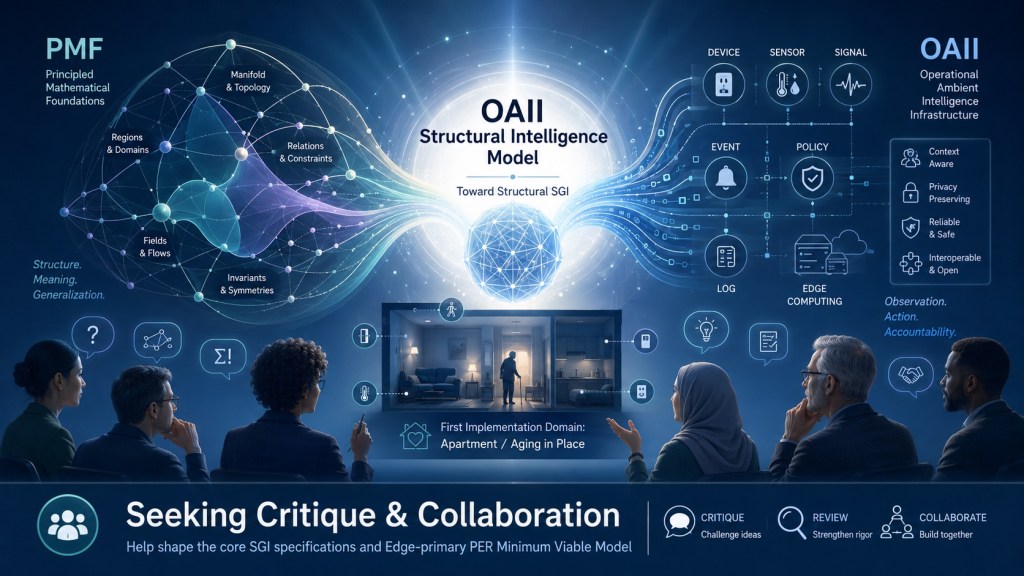
From PMF Framework Development to OAII Specifications
OAII is shifting from broad PMF framework development toward open SGI specifications and an Edge-primary PER Minimum Viable Model for aging-in-place.
-

Transformation, Time, and Temporal Projection in PMF
This OAII Concepts post refines the treatment of transformation and time within the Polarity Modeling Framework (PMF). Earlier PMF work defined transformation independently of time indexing, but practical autonomous intelligent systems still require ordering, duration, synchronization, and logging. The revision introduces Temporal Projection as a first-class framework construct that maps transformation structures into temporal reference…
-
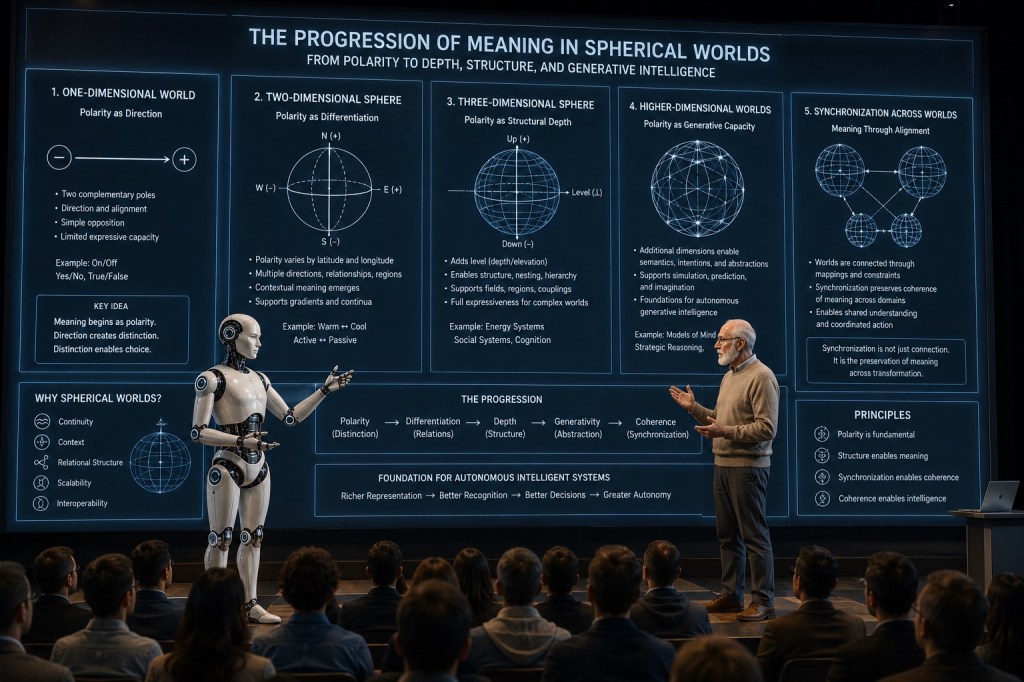
The Progression of Meaning in Spherical Worlds
This OAII Concepts post explains how the meaning of polarity changes as PMF worlds progress from one-dimensional structures to multi-dimensional spherical worlds. In a one-dimensional system, polarity primarily represents directional alignment between complementary poles. With the introduction of additional dimensions, polarity evolves into a richer structural framework capable of representing differentiation, coexistence, contextual variation, regions,…
-
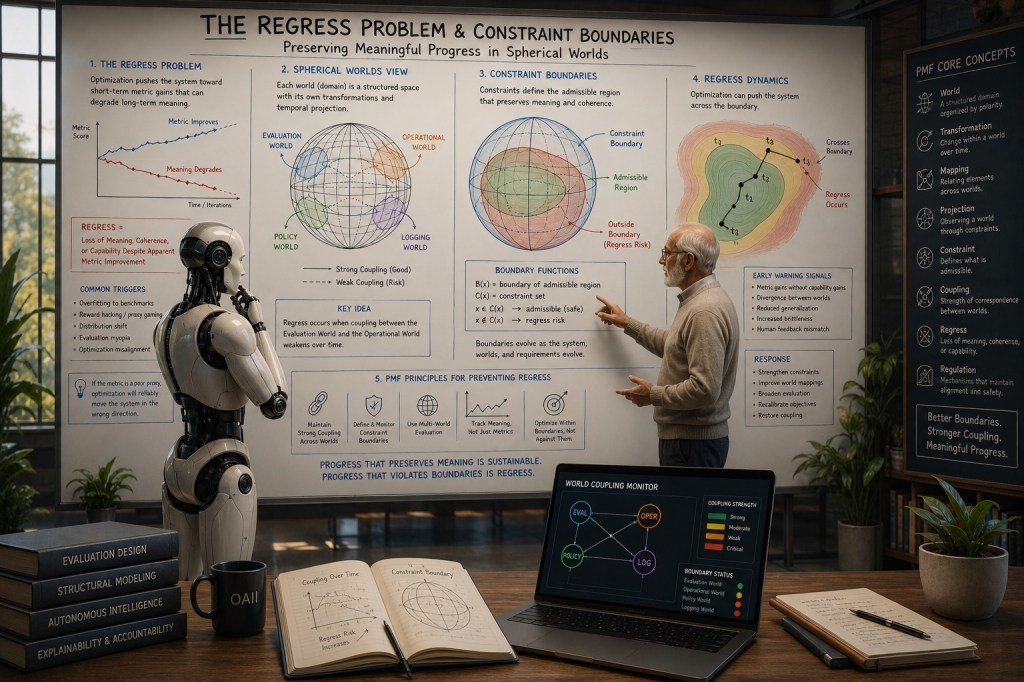
The Regress Problem and Constraint Boundaries in PMF
This OAII Concepts post explains how the meaning of polarity changes as PMF worlds progress from one-dimensional structures to multi-dimensional spherical worlds. In a one-dimensional system, polarity primarily represents directional alignment between complementary poles. With the introduction of additional dimensions, polarity evolves into a richer structural framework capable of representing differentiation, coexistence, contextual variation, regions,…
-

OAII Concepts: Integrating the Polarity Modeling Framework (PMF) into the OAII Base Model
This post introduces the integration of the Polarity Modeling Framework (PMF) into the Open Autonomous Intelligence Initiative (OAII) Base Model as a foundational structural layer. By separating operational entities from structural relationships, PMF provides a unified way to represent state, context, and transformation across autonomous intelligent systems. The result is a multi-world model that improves…
-

From Framework to Implementation: The Next Phase of the Open Autonomous Intelligence Initiative
A four-step plan for advancing the Polarity Modeling Framework from concept to implementation, including outreach, system design, and a Minimum Viable Model.

